Baby Copperhead Identification: Yellow Tail, Bands and Look-Alikes
Baby copperheads look like small adults: a tan to copper body with dark hourglass-shaped crossbands and a plain head, plus a bright yellow tail tip they wiggle as a lure for frogs and lizards. They are venomous from birth. Keep your distance and don't use any visual rule to decide a snake is safe.
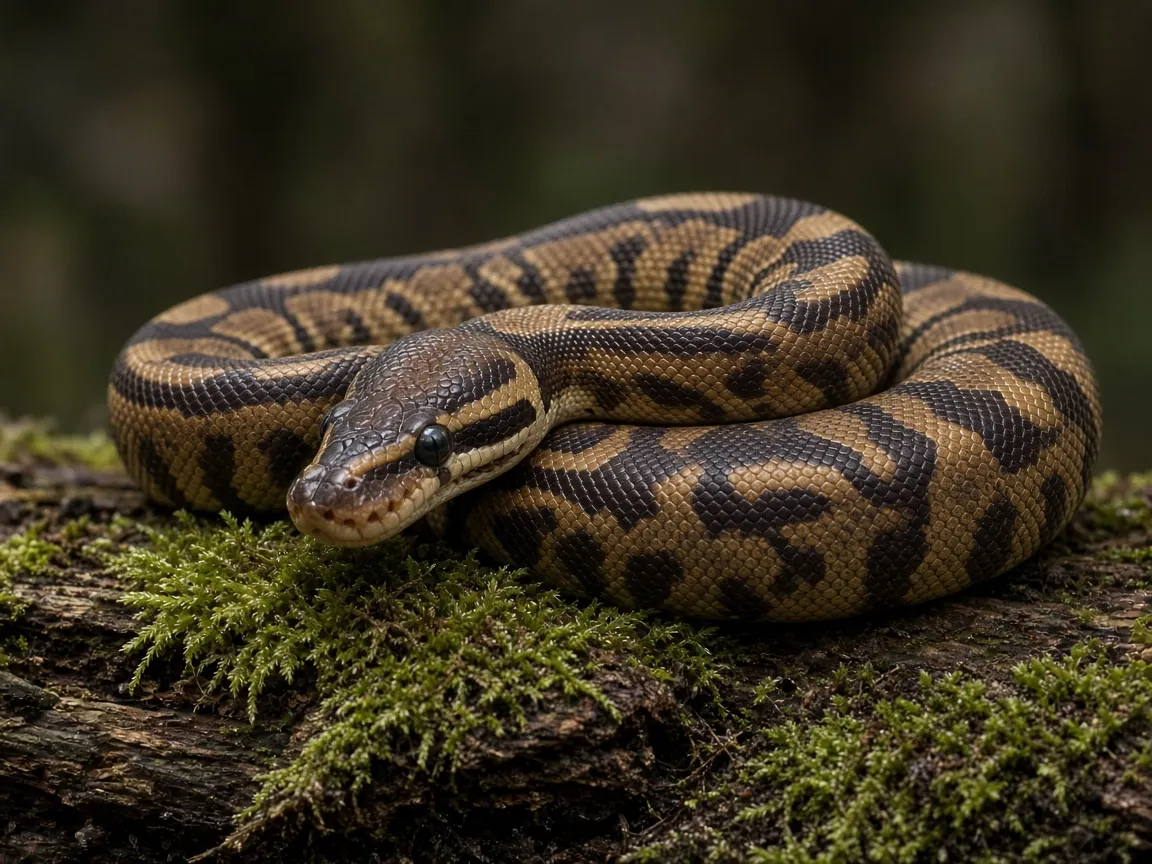
⚠️ Venom labels may be wrong. Treat every snake as potentially dangerous. See the safety warning above.
Quick facts
- Yellow tail tip: young copperheads are born with a bright yellow (sometimes greenish-yellow) tail tip that fades with age (UGA Savannah River Ecology Lab; Missouri Department of Conservation).
- Same pattern as adults: dark hourglass-shaped crossbands, narrow along the spine and wide at the sides, on a tan, copper or pinkish-brown body (UGA SREL; Missouri DOC).
- Plain head: a solid copper to tan head with no spear-point marking on top, unlike corn snakes (UGA SREL).
- Born venomous: newborns arrive with working fangs and venom glands (Missouri DOC). Litters are born live, mostly late summer to early autumn.
- Size at birth: about 20–25 cm (8–10 in) long (UGA SREL).
How to identify a baby copperhead
The most useful single clue is the tail. Newborn eastern copperheads (Agkistrodon contortrix) have a bright yellow tail tip, which the University of Georgia's Savannah River Ecology Laboratory (SREL) says fades as the snake grows. The Missouri Department of Conservation notes that "young eastern copperheads and some adults have a yellow tail tip", so a yellow tail points to a copperhead, but a plain tail doesn't rule one out.
Apart from the tail, a baby copperhead looks like a small adult. Both field guides describe 10–18 dark crossbands shaped like an hourglass: narrow across the middle of the back and wide on the sides. From the side, SREL says, the bands often look like a "Hershey's kiss". The body is light brown, tan, copper or pinkish-tan, and the scales are keeled, so the skin looks rough rather than glossy.
The head is usually a plain copper to tan colour without markings on top. Copperheads are pit vipers, with a heat-sensing pit between each nostril and eye, and they have vertical pupils (Missouri DOC). Don't lean on head shape: SREL points out that the triangular head is "not an identifying characteristic", because many harmless snakes flatten their heads when threatened. And none of these details should be checked up close. If you can see the pupils, you are too near.
Why do baby copperheads have yellow tails?
It's a lure. Young copperheads twitch the yellow tip in worm-like movements to draw frogs and lizards within striking range, a behaviour called caudal luring (UGA SREL; Missouri DOC). Adults switch mostly to mice and voles, which is one reason the lure loses its value with age.
Two peer-reviewed studies back this up. Pisani and Riedle (2018) analysed 5,084 copperhead records collected by Henry Fitch in northeast Kansas from 1948 to 2003. They found newborns and juveniles have relatively longer tails than adults and suggest that the longer tail, "combined with tail color, enhances the effectiveness of caudal luring". In a 2022 Royal Society Open Science paper, researchers scanned 18 pregnant copperheads by ultrasound and saw sinusoidal tail movements in 11 of 97 fetuses, from eight different mothers. These movements were "indistinguishable from caudal luring". Two rattlesnake species that don't caudal-lure showed no such movements before birth. The behaviour seems to be wired in before the snake is even born.
Baby copperhead vs. corn snake and other look-alikes
Many harmless brown, banded or blotched snakes get mistaken for copperheads. SREL singles out the corn snake. The differences it lists:
| Feature | Baby copperhead | Corn snake |
|---|---|---|
| Body markings | Hourglass crossbands (wide on the sides, narrow on top) | Blotches, usually darker-edged, that don't form hourglasses |
| Top of head | Plain copper or tan, no pattern | Spear-point marking between the eyes |
| Belly | Lightly mottled brown | Boldly checkered black and white |
| Scales | Keeled (rough look) | Smooth (glossy look) |
| Tail tip | Often bright yellow in young snakes | Not yellow-tipped |
Sources for the copperhead column: UGA SREL and Missouri DOC. Corn snake column: the SREL comparison on its copperhead page. Use this table to understand why the snakes get confused, not to decide whether a snake near you is safe. Young snakes vary, colours change in different light, and several features can be hard to see without getting dangerously close. See Venomous or Not? for why no visual rule is foolproof.
Are baby copperheads more dangerous than adults?
You'll often hear that baby snakes are more dangerous because they "can't control their venom". We couldn't find a peer-reviewed study showing this for copperheads, so we don't repeat it. What is documented: newborns have working fangs and venom from birth (Missouri DOC), and any copperhead bite needs medical care.
The good news is that copperhead bites are rarely fatal. A review of US snakebite deaths from 1989 to 2018 found 101 fatal bites from native snakes, of which five were attributed to copperheads; rattlesnakes caused most deaths (Greene et al., 2021). An older national estimate put the copperhead case-fatality rate at about 0.01%, and found most bites happened in people's own yards, 98% on the arms or legs (Parrish & Carr, 1967). In a Texas hospital series of 88 copperhead bites from 1995 to 2010, 85% were mild (grade 1) and there were no deaths (Walker & Morrison, 2011). Rare deaths aren't the same as harmless, though: poison-centre data rank copperhead bites, with rattlesnake bites, among those with the most severe outcomes, especially in children under six (Seifert et al., 2009).
If someone is bitten: call local emergency services or poison control straight away and get to hospital. Don't rely on this site. Keep still, remove rings and tight items near the bite, and don't cut, suck or put a tourniquet on the wound. See our snake safety guide.
What to do if you find a baby copperhead
Leave it alone and keep children and pets away. Baby copperheads are born in late summer and early autumn, often near rotting logs or rock crevices, and the mother may stay near the birth site until the young disperse (UGA SREL), so one sighting can mean others nearby. If a snake is in your home or somewhere it can't be left, call a local wildlife professional or animal control. For an injured or captive snake, consult a herpetologist or exotic-animal vet. Never try to pick one up, even a dead one.
Related reading: venom vs. constriction, how snakes warn before biting, and snake species profiles.
FAQ
Do all baby copperheads have yellow tails?
Most newborns have a bright yellow tail tip that fades with age, and some adults keep it (Missouri DOC; UGA SREL). A plain tail doesn't prove a snake isn't a copperhead.
What does a baby copperhead look like?
A small version of the adult: tan to copper body with dark hourglass-shaped crossbands, a plain unpatterned head, and usually a bright yellow tail tip. Newborns are about 20–25 cm long (UGA SREL).
How can you tell a baby copperhead from a corn snake?
Copperheads have hourglass bands, a plain head and a mottled belly. Corn snakes have blotches, a spear-point mark on the head and a boldly checkered belly (UGA SREL). Don't get close to check; treat any unknown snake as dangerous.
Are baby copperheads venomous?
Yes. They are born with working fangs and venom glands (Missouri DOC). Any bite needs emergency medical care. Call local emergency services or poison control; don't rely on this site.
When are baby copperheads born?
Copperheads give birth to live young, mostly from August to early October in Missouri (Missouri DOC), in litters of about 3–15 depending on region (Missouri DOC; UGA SREL).
Sources
- Pisani, G. R., & Riedle, J. D. (2018). Ontogenetic changes in tail-length and the possible relation to caudal luring in northeast Kansas copperheads, Agkistrodon contortrix. Transactions of the Kansas Academy of Science, 121(3/4), 403–410. doi:10.1660/062.121.0417
- Tail movements by late-term fetal pitvipers resemble caudal luring: prenatal development of an ambush predatory behaviour. (2022). Royal Society Open Science. doi:10.1098/rsos.220218
- Greene, S. C., Folt, J., Wyatt, K., & Brandehoff, N. P. (2021). Epidemiology of fatal snakebites in the United States 1989–2018. American Journal of Emergency Medicine, 45, 309–316. PubMed 33046301
- Parrish, H. M., & Carr, C. A. (1967). Bites by copperheads (Ancistrodon contortrix) in the United States. JAMA, 201(12), 927–932. doi:10.1001/jama.1967.03130120035009
- Walker, J. P., & Morrison, R. L. (2011). Current management of copperhead snakebite. Journal of the American College of Surgeons, 212(4), 470–474. PubMed 21463771
- Seifert, S. A., Boyer, L. V., Benson, B. E., et al. (2009). AAPCC database characterization of native U.S. venomous snake exposures, 2001–2005. Clinical Toxicology, 47(4), 327–335. PubMed 19514880
- University of Georgia Savannah River Ecology Laboratory. Eastern Copperhead (Agkistrodon contortrix).
- Missouri Department of Conservation. Eastern Copperhead field guide.
Cite this page
APA: SnakeWise. (2026, October 26). Baby Copperhead Identification: Yellow Tail, Bands and Look-Alikes. SnakeWise. https://snakewise.org/blog/baby-copperhead-identification.html
MLA: "Baby Copperhead Identification: Yellow Tail, Bands and Look-Alikes." SnakeWise, 26 Oct. 2026, snakewise.org/blog/baby-copperhead-identification.html.
Chicago: SnakeWise. "Baby Copperhead Identification: Yellow Tail, Bands and Look-Alikes." SnakeWise. October 26, 2026. https://snakewise.org/blog/baby-copperhead-identification.html.