Can Snakes See Heat? How Pit Vipers Sense Infrared
Yes, some snakes can sense heat. Pit vipers such as rattlesnakes, plus pythons and boas, have pit organs on their faces that detect infrared radiation from warm bodies, even in total darkness. The pits work by being warmed, through heat-sensitive TRPA1 channels, not like eyes, and a rattlesnake can react to a mouse-warm target up to 1 metre away.
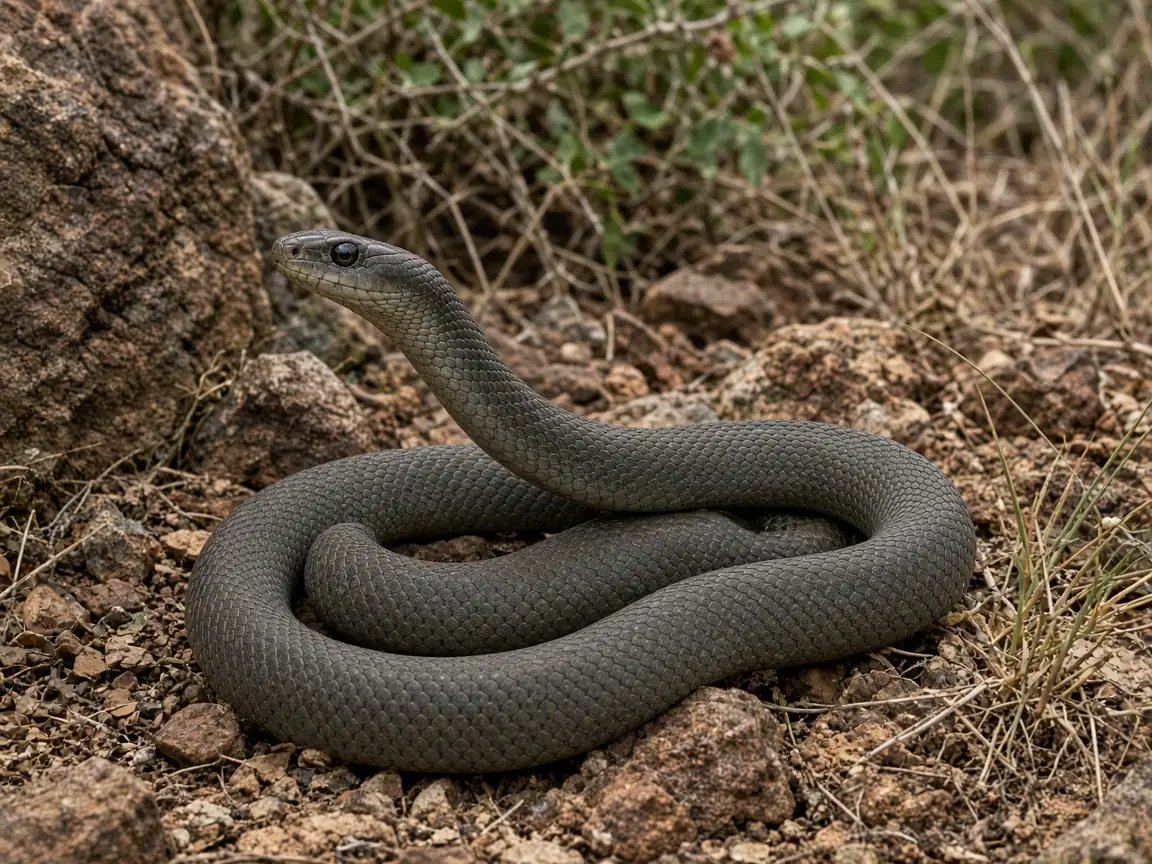
Quick facts
- Which snakes sense heat: pit vipers (such as rattlesnakes), pythons and boas. Among vertebrates, only these snakes and vampire bats are known to detect infrared radiation (Gracheva et al., 2011).
- How it works: infrared warms a thin membrane inside the pit, and heat-sensitive TRPA1 ion channels on nerve endings fire. It is a heat sense, not light-sensing like an eye (Gracheva et al., 2010).
- Range: western diamondback rattlesnakes reacted to a mouse-sized, mouse-warm target up to 100 cm away (Ebert & Westhoff, 2006).
- In the brain: heat and vision signals are combined in the same brain region, the optic tectum (Hartline, Kass & Loop, 1978).
- Not just for hunting: rattlesnakes also use their pits to find cooler or warmer shelters (Krochmal & Bakken, 2003).
Can snakes see heat?
Some can, in a way. Pit vipers, pythons and boas have special pit organs on their faces that detect infrared (heat) radiation, which lets them build a rough "thermal image" of warm prey or predators, even in total darkness (Gracheva et al., 2010). Snakes without pits, including the true vipers of Africa and Eurasia (Viperinae), cannot use heat this way (Krochmal, Bakken & LaDuc, 2004).
Snakes don't "see" heat with their eyes. The pits are wired to the trigeminal nerve, the same nerve system that carries touch and temperature from the face, not to the optic nerve. Vampire bats evolved a similar trick on their noses to find warm spots on prey, which makes snakes and vampire bats the only vertebrates known to sense infrared this way (Gracheva et al., 2011).
How does a pit organ detect heat?
A pit viper's pit is a small cavity with a thin, nerve-packed membrane stretched across it, with an air chamber behind. Warm objects give off infrared radiation, which passes through the opening and slightly heats the membrane. In 2010, researchers at the University of California, San Francisco found the sensor that turns that warming into nerve signals: an ion channel called TRPA1. The versions of TRPA1 in vipers, pythons and boas were the most heat-sensitive vertebrate ion channels found up to then. So snakes detect infrared through radiant heating of the pit, not through a light-sensitive chemical like the pigments in an eye (Gracheva et al., 2010).
Because the system runs on heat, it has to cool down quickly or old images would linger. Studies of pit vipers (Gloydius and Trimeresurus) showed that blood flow speeds up exactly where an infrared laser hits the pit membrane. The researchers suggest the dense network of blood vessels works as a cooling system for the heat receptors (Goris et al., 2007).
How sharp is a snake's heat vision?
Fuzzy, but amazingly sensitive. An optical and heat-flow analysis of the facial pit found that the image formed on the membrane is poorly focused and very low in contrast, because the pit opening is wide, like a pinhole camera with a hole that is too big. To explain what snakes actually manage to do, the nerve endings would need to respond to temperature differences of 0.001 °C or less. The brain probably sharpens the image, and choosing a spot with an even background helps (Bakken & Krochmal, 2007).
Behaviour tests back up how sensitive it is. When a moving infrared source about the size and temperature of a mouse was shown to western diamondback rattlesnakes (Crotalus atrox), the snakes reacted with head jerks, freezing, rattling and tongue-flicking at distances up to 100 cm. That was 3.2 times more sensitive than earlier nerve recordings had suggested (Ebert & Westhoff, 2006).
Do snakes combine heat and normal vision?
Yes. In rattlesnakes, infrared signals end up in the optic tectum, a brain area that also handles vision. A layer of heat-sensitive neurons sits just below the visual layer, and some neurons respond to both heat and light. The heat and visual maps line up closely but not perfectly, and these cells probably help the snake turn and strike toward prey (Hartline, Kass & Loop, 1978). Mapping in prairie rattlesnakes and pygmy rattlesnakes confirmed the two layers mix in one sublayer, where most of the two-sense neurons are found (Kass, Loop & Hartline, 1978).
How do rattlesnakes use heat to hunt?
Field studies of sidewinder rattlesnakes (Crotalus cerastes) in the desert show how this works in the wild. When researchers offered lizard carcasses at different temperatures, the snakes were more likely to respond, and responded from further away, at night and when the lizard stood out strongly from its background. The lizard's actual temperature didn't matter, so the snakes seem to use heat to spot prey rather than judge it (Schraft, Goodman & Clark, 2018).
Where a sidewinder faces while it waits in ambush matters too. Thermal-camera panoramas taken from real ambush sites showed the snakes tended to face directions with sharp temperature edges, such as the boundary between sun-warmed and shaded ground. A warm animal crossing that edge likely creates a fast-changing signal that is easy to notice (Schraft, Bakken & Clark, 2019).
Are heat pits only for hunting?
No. Western diamondback rattlesnakes with working pits chose good-temperature retreat sites using heat cues alone, but failed when their pits were blocked (Krochmal & Bakken, 2003). A follow-up test of 12 pit viper species found that every one could use its pits to guide thermoregulation, while a true viper without facial pits could not. The authors suggest the pits may first have evolved to help snakes find the right temperature, and only later became prey detectors (Krochmal, Bakken & LaDuc, 2004).
What this means for safety
A pit viper can sense your body heat in the dark, so night walks in rattlesnake country call for a torch, closed shoes and watching where you step. A snake that freezes or turns its head toward you may already know you are there. Keep your distance and never try to handle it. See our snake safety page for what to do if you meet one or someone is bitten, and the venomous or not ID guide for how pit vipers differ from harmless lookalikes. Remember that labels and ID tips can be wrong, so treat every snake as dangerous.
Learn more about snake senses and bodies on our snake anatomy page, meet rattlesnakes, pythons and boas in the species guide, see where they live on the habitats page, read can snakes hear? and how do sidewinders move?, or browse in the SnakeWise shop.
FAQ
Can snakes see in the dark?
Pit vipers, pythons and boas can find warm prey in darkness using heat-sensing pit organs on their faces (Gracheva et al., 2010). Other snakes rely on smell, the tongue and whatever light is available.
Which snakes have heat-sensing pits?
Pit vipers (rattlesnakes and their relatives), pythons and boas. Among vertebrates, only these snakes and vampire bats are known to detect infrared (Gracheva et al., 2011).
How far away can a rattlesnake sense heat?
In lab tests, western diamondback rattlesnakes reacted to a mouse-sized, mouse-warm target up to 100 cm away (Ebert & Westhoff, 2006).
Why did heat pits evolve?
They are used for hunting, but rattlesnakes and 11 other pit viper species also use them to choose places with the right temperature, which may be how the pits first evolved (Krochmal & Bakken, 2003; Krochmal, Bakken & LaDuc, 2004).
Sources
- Gracheva, E. O., Ingolia, N. T., Kelly, Y. M., Cordero-Morales, J. F., Hollopeter, G., Chesler, A. T., Sánchez, E. E., Perez, J. C., Weissman, J. S., & Julius, D. (2010). Molecular basis of infrared detection by snakes. Nature, 464(7291), 1006–1011. doi:10.1038/nature08943
- Gracheva, E. O., Cordero-Morales, J. F., González-Carcacía, J. A., Ingolia, N. T., Manno, C., Aranguren, C. I., Weissman, J. S., & Julius, D. (2011). Ganglion-specific splicing of TRPV1 underlies infrared sensation in vampire bats. Nature, 476(7358), 88–91. doi:10.1038/nature10245
- Bakken, G. S., & Krochmal, A. R. (2007). The imaging properties and sensitivity of the facial pits of pitvipers as determined by optical and heat-transfer analysis. Journal of Experimental Biology, 210(16), 2801–2810. doi:10.1242/jeb.006965
- Ebert, J., & Westhoff, G. (2006). Behavioural examination of the infrared sensitivity of rattlesnakes (Crotalus atrox). Journal of Comparative Physiology A, 192(9), 941–947. doi:10.1007/s00359-006-0131-8
- Hartline, P. H., Kass, L., & Loop, M. S. (1978). Merging of modalities in the optic tectum: infrared and visual integration in rattlesnakes. Science, 199(4334), 1225–1229. doi:10.1126/science.628839
- Kass, L., Loop, M. S., & Hartline, P. H. (1978). Anatomical and physiological localization of visual and infrared cell layers in tectum of pit vipers. Journal of Comparative Neurology, 182(4), 811–820. doi:10.1002/cne.901820505
- Krochmal, A. R., & Bakken, G. S. (2003). Thermoregulation is the pits: use of thermal radiation for retreat site selection by rattlesnakes. Journal of Experimental Biology, 206(15), 2539–2545. doi:10.1242/jeb.00471
- Krochmal, A. R., Bakken, G. S., & LaDuc, T. J. (2004). Heat in evolution's kitchen: evolutionary perspectives on the functions and origin of the facial pit of pitvipers (Viperidae: Crotalinae). Journal of Experimental Biology, 207(24), 4231–4238. doi:10.1242/jeb.01278
- Schraft, H. A., Goodman, C., & Clark, R. W. (2018). Do free-ranging rattlesnakes use thermal cues to evaluate prey? Journal of Comparative Physiology A, 204(3), 295–303. doi:10.1007/s00359-017-1239-8
- Schraft, H. A., Bakken, G. S., & Clark, R. W. (2019). Infrared-sensing snakes select ambush orientation based on thermal backgrounds. Scientific Reports, 9, 3950. doi:10.1038/s41598-019-40466-0
- Goris, R. C., Atobe, Y., Nakano, M., Funakoshi, K., & Terada, K. (2007). Blood flow in snake infrared organs: response-induced changes in individual vessels. Microcirculation, 14(2), 99–110. doi:10.1080/10739680601131184
Cite this page
APA: SnakeWise. (2026, October 27). Can Snakes See Heat? How Pit Vipers Sense Infrared. SnakeWise. https://snakewise.org/blog/can-snakes-see-heat.html
MLA: "Can Snakes See Heat? How Pit Vipers Sense Infrared." SnakeWise, 27 Oct. 2026, snakewise.org/blog/can-snakes-see-heat.html.
Chicago: SnakeWise. "Can Snakes See Heat? How Pit Vipers Sense Infrared." SnakeWise. October 27, 2026. https://snakewise.org/blog/can-snakes-see-heat.html.