Can Snakes Swim? What Tests Show Across 500+ Species | SnakeWise
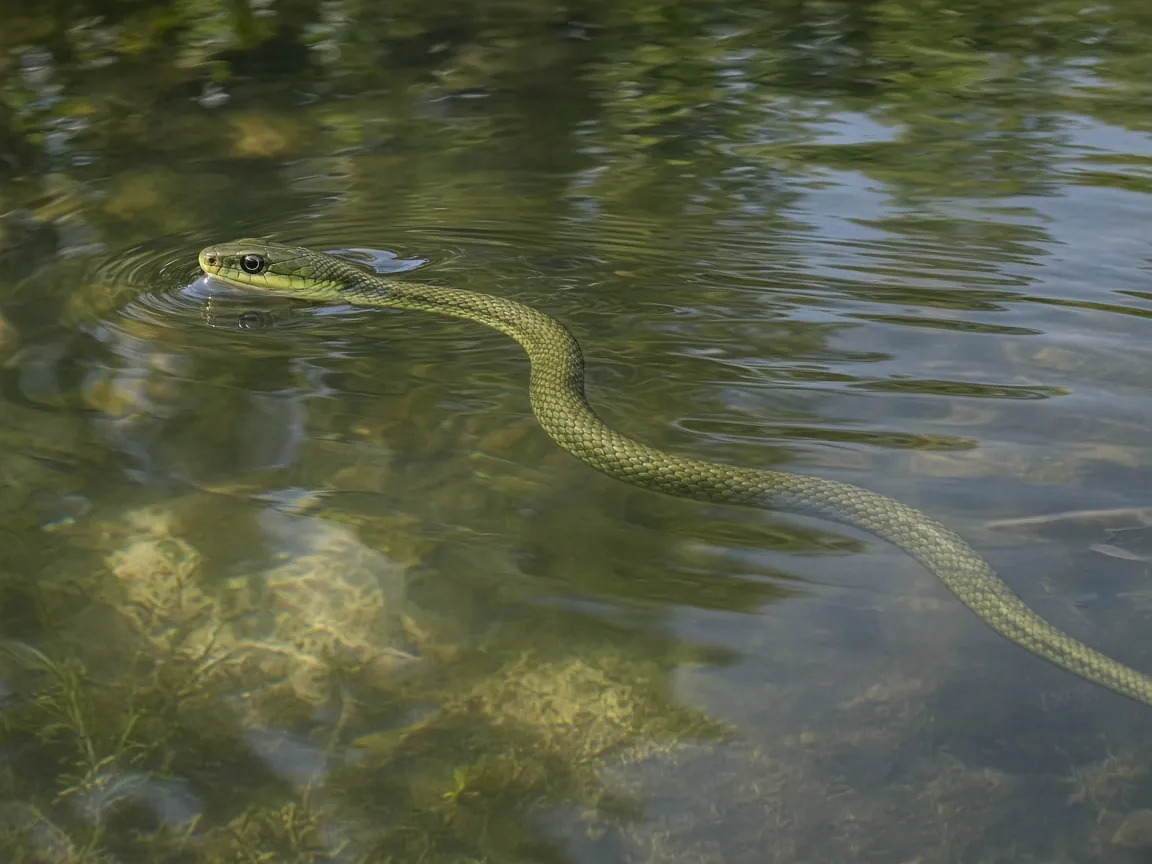
Yes. Every snake species tested so far has been able to swim. A 2024 Zoology review and new trials found swimming ability in 525 species and no confirmed non-swimmer among those tested.
Quick facts
- Can snakes swim? Every snake species tested so far has been able to swim. A 2024 Zoology review plus new swim trials found no non-swimmer among 525 species with data (Segall et al., 2024).
- How they swim: lateral undulation, the same side-to-side wave used on land, transferred into water. They have no fins.
- Who is fastest: semi-aquatic species tend to post the highest swimming speeds; fully aquatic sea snakes are often slower in comparable tests (Zoological Research, 2025).
- Temperature matters: in amphibious snakes, swimming performance rises sharply with water temperature (for example, about 2.5 times faster at 30 °C than at 10 °C in one foraging study).
- Sea snakes: they still breathe air. Dive length shortens in warmer water as metabolism rises (Journal of Experimental Biology, 2016).
Can all snakes swim?
Popular claims say every snake can swim. Until recently that claim was mostly anecdotal. Segall and colleagues (2024) ran a systematic review of swimming reports across 3,951 snake species and found published or video evidence for only about 11% of them, heavily skewed toward aquatic and semi-aquatic colubroids. Important early lineages and burrowing forms were almost missing from the record.
To close that gap they tested 103 snake species spanning lifestyles and phylogeny, including fossorial scolecophidians. Every individual tested swam. Combined with earlier reports, swimming ability is now documented for 525 species, and no tested species failed. The authors conclude swimming ability alone does not discriminate ancestral lifestyle hypotheses, because lateral undulation works in water for many limbless tetrapods.
How snakes swim without fins
Snakes propel themselves with lateral undulatory waves that travel along the body. Frequency and lateral velocity of those waves correlate strongly with swimming speed; wavelength tends to correlate negatively (Zoological Research, 2025). Semi-aquatic taxa in that seven-species comparison reached the highest speeds, while fully aquatic sea snakes were among the slowest, showing that living in water is not the same as being the fastest swimmer.
Maneuverability is another story. Without fins, snakes still make tight turns by changing body posture to manage torque and moment of inertia (Turning without fins, 2024/2025 engineering-biology analysis). That helps explain why a water snake can loop around aquatic plants instead of needing a rudder.
Temperature, diving and real-world limits
Cold water slows snakes. Performance in amphibious snakes rose with test temperature across 10 to 30 °C ranges in foraging-tactic research. Sea snakes face a related trade-off underwater: they are air-breathers, and warmer water raises metabolism, so aerobic dive capacity shrinks. In one study of Hydrophis curtus, mean dive duration fell from about 40 minutes near 21 °C to about 11 minutes near 30 °C (Journal of Experimental Biology, 2016).
Terrestrial snakes that fall into ponds or canals can usually paddle to a bank. That does not mean every species chooses water, or that a tired snake in a cold, fast current is safe. Habitat and physiology still set hard limits.
For a fully aquatic lifestyle example, see how sea snakes exchange gases. Land locomotion contrasts are on how sidewinders move and our movement page.
FAQ
Can all snakes swim?
Every snake tested so far can swim. A 2024 review plus new trials documented swimming in 525 species and found no non-swimmer among those tested.
How do snakes swim?
They use lateral undulation: side-to-side body waves that push against the water. They do not use fins.
Are sea snakes the fastest swimming snakes?
Not necessarily. Comparative work finds semi-aquatic species often swim faster than fully aquatic sea snakes.
Does water temperature change swimming?
Yes. Cooler water slows swimming, and for diving sea snakes warmer water shortens typical dive times because metabolism rises.
Sources
- Segall, M., et al. (2024). Can all snakes swim? A review of the evidence and testing species across phylogeny and morphological diversity. Zoology. doi:10.1016/j.zool.2024.126223
- Intraspecific and interspecific variations in the swimming characteristics of snakes according to their lifestyle. Zoological Research (2025). doi:10.24272/j.issn.2095-8137.2025.113
- Coming up for air: thermal dependence of dive behaviours and metabolism in sea snakes. Journal of Experimental Biology (2016). doi:10.1242/jeb.143743
- Turning without fins: how snakes achieve high maneuverability while swimming (HAL preprint / related analysis). hal.science
Cite this page
APA: SnakeWise. (2026, November 5). Can Snakes Swim? What Tests Show Across 500+ Species | SnakeWise. SnakeWise. https://snakewise.org/blog/can-snakes-swim.html
MLA: "Can Snakes Swim? What Tests Show Across 500+ Species | SnakeWise." SnakeWise, 5 Nov. 2026, snakewise.org/blog/can-snakes-swim.html.
Chicago: SnakeWise. "Can Snakes Swim? What Tests Show Across 500+ Species | SnakeWise." SnakeWise. November 5, 2026. https://snakewise.org/blog/can-snakes-swim.html.