Study: Tiny Dwarf Reed Snakes Cartwheel to Escape, and Keep Their Heads Steady
Some very small snakes in Borneo escape danger by cartwheeling. A new study in Current Biology filmed three species of dwarf reed snake (Pseudorabdion) rolling head over tail down a lab racetrack at 1.7 to 3.7 metres per second, and found they keep their heads fairly steady the whole time. Close relatives in the genus Calamaria never rolled.
The news in brief
- What: a step-by-step video analysis of cartwheeling in snakes, a rare escape behaviour.
- Who: Yosuke Kojima (Toho University, Japan), Ibuki Fukuyama, Mohamad Yazid Hossman, Clement Het Kaliang and Kanto Nishikawa.
- Where published: Current Biology, volume 36, issue 20 (October 2026), pages R1061 to R1063. Science News reported on it on 19 October 2026.
- Snakes studied: 11 Pseudorabdion saravacense, one P. collaris and one P. longiceps, plus six Calamaria reed snakes for comparison, all collected in Kubah National Park, Sarawak, Malaysia.
- Main finding: every Pseudorabdion snake cartwheeled when tapped; none of the Calamaria snakes did.
What is a dwarf reed snake?
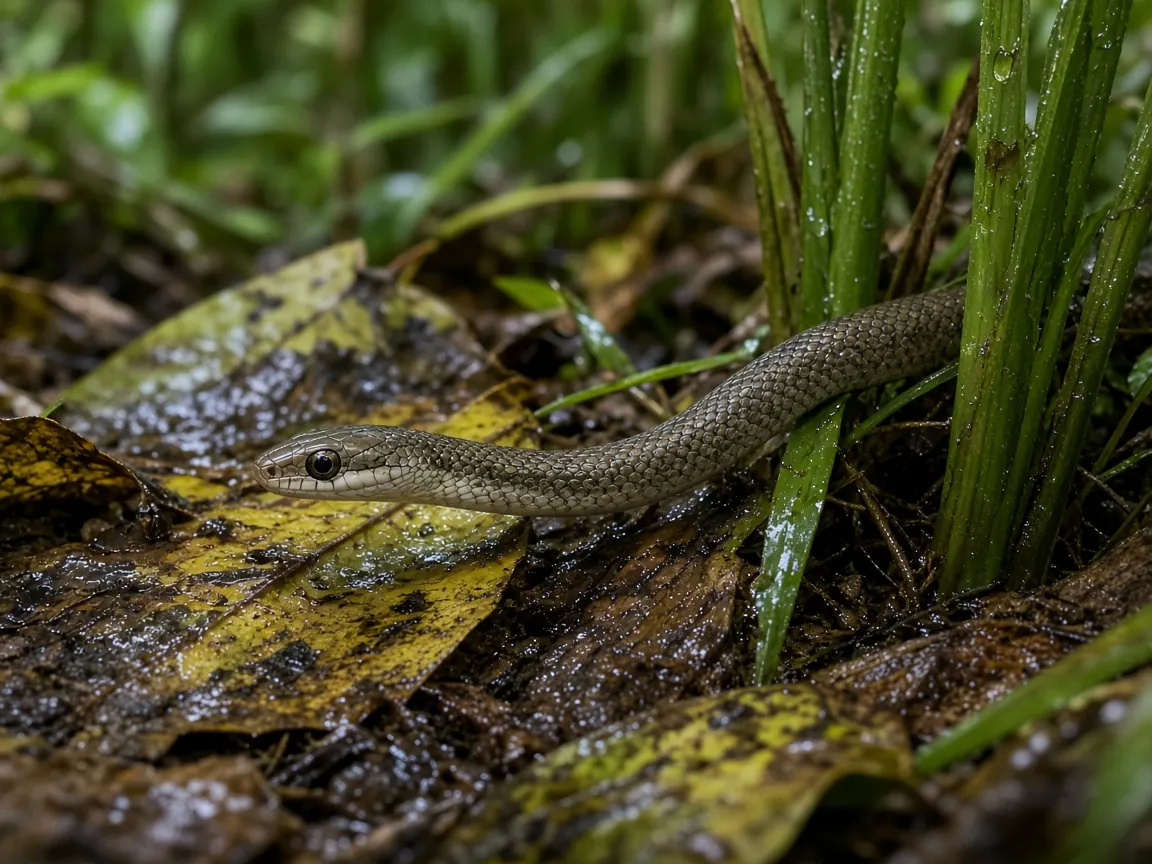
Dwarf reed snakes are tiny, secretive snakes from Southeast Asia. The ones in this study were only about 11 to 28 centimetres long, and Kojima told Science News that they "always hide under the leaves", which made them hard to find. Cartwheeling in these snakes was first formally described in 2023, when Evan Quah, Lee Grismer and Shahrul Anuar reported a dwarf reed snake (Pseudorabdion longiceps) using the rolling motion to escape. Their paper in Biotropica called it a rare escape mechanism that had not been documented in detail for any other snake or reptile.
How does a snake cartwheel?
The team built a 2.2-metre racetrack, placed each snake at one end, gave it a gentle tap and filmed it from above and from the side. As Science News describes the videos, each roll goes like this:
- The snake curls its body into a C shape, with its head lifted and facing the way it is going.
- It whips its tail out behind it and is briefly airborne.
- It flips its tail forward, up and over, and down past its head, landing it on either the left or the right side.
- When the tail hits the ground in front, the next roll begins.
At full speed the snakes tumbled at 1.7 to 3.7 metres per second, which is roughly 6 to 13 kilometres per hour. That is quick going for an animal shorter than a 30-centimetre ruler. For comparison with the everyday ways snakes get around, see our guide to how snakes move, including lateral undulation and sidewinding.
Why do they keep their heads steady?
Rolling fast poses a mechanical challenge: as the study's abstract notes, body rotation tends to destabilise the head, especially at high speeds. The researchers report a behavioural solution. Throughout the rolls the snakes held their heads fairly steady, which the researchers compare to the way flying snakes keep their heads stable while launching into the air.
What is still unknown?
Jessica Tingle, a biologist at Brown University who was not involved in the study, told Science News she is curious how such a demanding movement evolved, and whether dwarf reed snakes have something special in their anatomy, physiology or nervous system that their close relatives lack. Those questions are still open. She also noted that 19th-century writers described "hoop snakes" that rolled, a story she had assumed was invented; whether those accounts described this behaviour is not known, but it is neat that a real snake does something like it. For more snake stories that are and aren't true, see our myths vs facts page.
Keep exploring
Sources
- Kojima, Y., Fukuyama, I., Hossman, M. Y., Kaliang, C. H., & Nishikawa, K. (2026). Locomotor kinematics and head stabilization in rolling snakes. Current Biology, 36(20), R1061–R1063. doi:10.1016/j.cub.2026.08.057
- Quah, E. S. H., Grismer, L. L., & Anuar, M. S. S. (2023). Observations and description of a rare escape mechanism in a snake: Cartwheeling in Pseudorabdion longiceps (Cantor, 1847) (Squamata, Colubridea). Biotropica. doi:10.1111/btp.13213
- Temming, M. (2026, October 19). These tiny snakes cartwheel to escape danger. Science News. sciencenews.org
This post is written in our own words from the papers' bibliographic records (checked via Crossref), the 2023 paper's abstract and the Science News report. Short quotes are attributed. No images are used; the share image is SnakeWise's own.
Cite this page
APA: SnakeWise. (2026, October 20). Study: Tiny Dwarf Reed Snakes Cartwheel to Escape, and Keep Their Heads Steady. SnakeWise. https://snakewise.org/blog/dwarf-reed-snakes-cartwheel-escape-study.html