Why and How Do Snakes Shed Their Skin? Ecdysis Explained
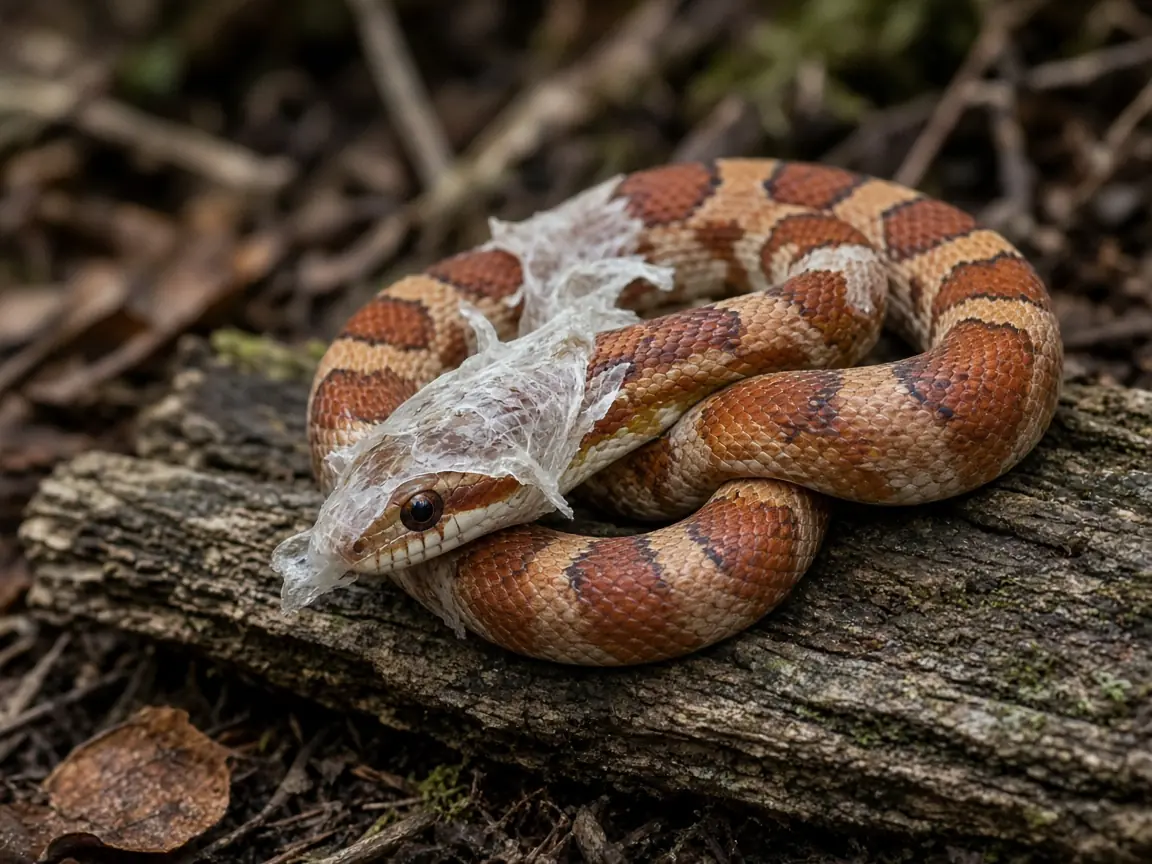
Snakes shed their outer skin, called ecdysis, because that layer is dead tissue that cannot stretch to keep up with growth or heal everyday wear. Young, fast-growing snakes shed every few weeks to months; many adults settle into about once a year. Days before each shed, a snake often goes cloudy-eyed as fluid loosens the old layer.
Quick facts
- Short answer: a snake's outer skin is dead, non-growing tissue, so a new, larger layer forms underneath and the old one is shed, usually in one connected piece (ecdysis).
- Frequency by age: fast-growing hatchlings and juveniles shed every few weeks to months; many adults settle into roughly one shed a year, though sex, condition and reproduction change the pattern (Macartney et al. 1990; Carnes-Mason & Beaupré 2023).
- Energy cost: in timber rattlesnakes, one shed takes nearly four weeks start to finish and uses about 3% of a snake's annual energy budget (Carnes-Mason, Ortega & Beaupré 2024).
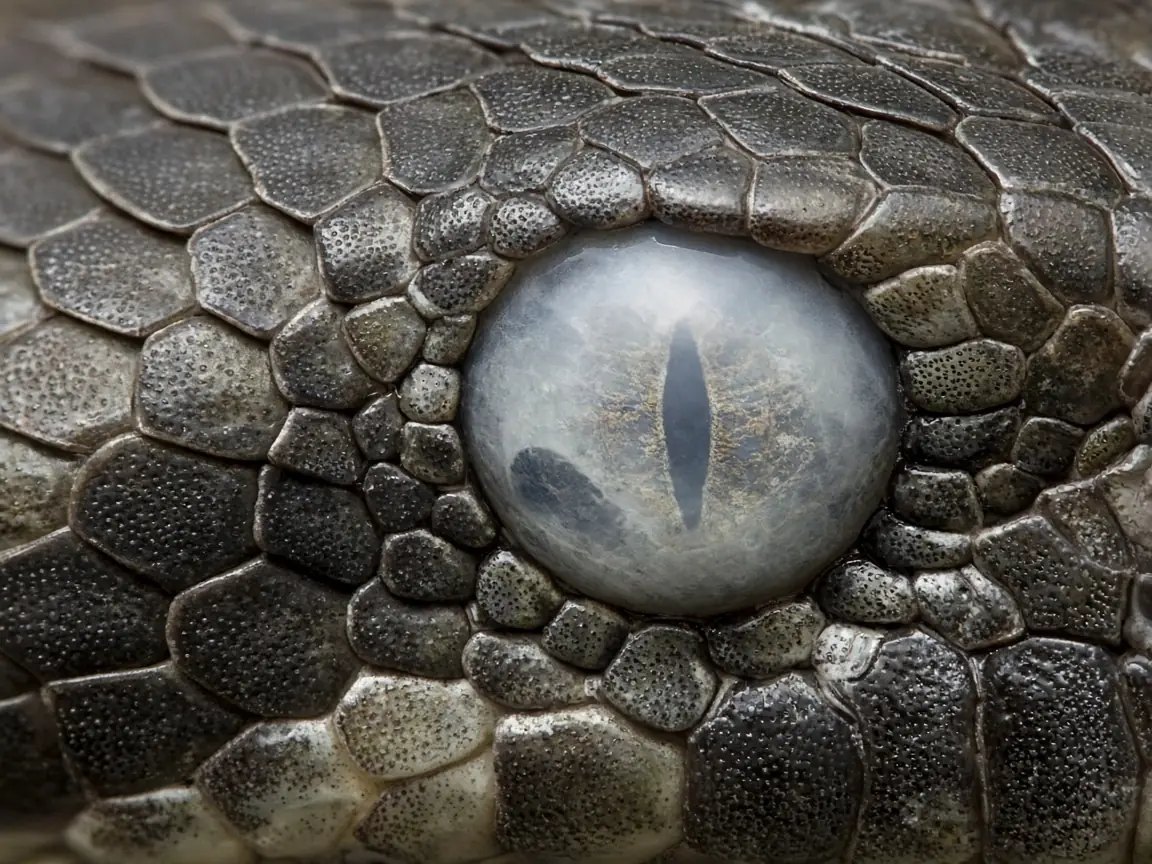
- Blue-eye phase: days before shedding, lymph fluid builds up under the old skin, including over each eye's clear "spectacle," turning it milky or bluish and blurring vision (Hellebuyck & Solanes Vilanova 2023; van Doorn & Sivak 2013).
- What a shed doesn't tell you: a rattlesnake gains a segment at every shed, not every year, and segments break off, so counting them does not reveal its age (Pennsylvania Fish and Boat Commission).
Why do snakes shed their skin?
A snake's outer skin, the hardened, keratin-filled stratum corneum, is made of dead cells once it finishes forming. Like the dead cells on human skin's surface, it cannot grow and cannot repair itself if scraped or worn. A snake's body works around this by building a whole new, larger skin layer underneath the old one, then shedding the worn layer in a process called ecdysis, usually in one connected piece. See the glossary entry for ecdysis.
Shedding as a single sheet, rather than the small flakes most lizards and geckos lose, is distinctive to snake skin. A 2017 genomic study found snakes evolved their own set of keratin-related genes that let the whole outer layer separate as one cohesive sheet (Holthaus et al. 2017). Growth and renewal of worn skin are the main, well-established drivers. Whether shedding also removes external parasites in snakes is less certain: a controlled experiment found it clearly reduced mite numbers in six gecko species, close relatives of snakes, but no equivalent study has been published for snakes (Fushida et al. 2020), so that part of the common claim remains an extrapolation rather than a tested result.
How does the shedding process actually work?
Shedding follows a set sequence of tissue changes, first mapped out by biologist P. F. A. Maderson, who divided the cycle into six histological stages based on skin from the Chinese stripe-tailed ratsnake and nine other genera (Maderson 1965). Basal cells multiply and form a fresh outer layer under the old one, then a thin, lymph-filled "cleavage zone" opens between the two layers, loosening the dead outer skin until the snake works its way free, usually peeling it off inside-out from the head.
The cycle is partly hormone-controlled: removing the thyroid gland in an experiment on the shovel-nosed snake disrupted normal shedding, and injecting thyroid hormone helped trigger it (Chiu & Lynn 1970). It also costs real time and energy. Respirometry on wild-caught timber rattlesnakes found a single shed takes nearly four weeks from the start of new-skin production to the final peeling, and that building the new skin, not removing the old one, is the energetically expensive part, costing roughly 3% of a snake's annual energy budget (Carnes-Mason, Ortega & Beaupré 2024).
How often do snakes shed, and does that change with age?
Yes, noticeably. Hatchlings and juveniles grow quickly, and dead skin cannot stretch to keep up, so young snakes typically shed every few weeks to months. As growth slows with age, shedding generally becomes less frequent. In a long-term study of western rattlesnakes in British Columbia, adults of both sexes settled into roughly one shed per year, while juvenile growth, and so presumably shedding, stayed far more variable (Macartney et al. 1990).
Even adults are not perfectly regular. A 25-year radio-telemetry study of free-ranging timber rattlesnakes found that male shedding frequency tracked body condition, while female frequency tracked reproductive state: gravid females shed earlier in the year than non-gravid females (Carnes-Mason & Beaupré 2023). So in adults, shedding can be tied to reproduction and condition as much as growth, which is one reason a healthy pet snake's shed schedule varies year to year. See our pet snake basics guide for more; a snake struggling to shed is a reason to ask a reptile vet rather than diagnose it at home.
What is the "blue-eye" phase, and why do a snake's eyes turn cloudy?
Snakes have no eyelids. Each eye is permanently covered by a clear, immovable scale called the spectacle, or brille, which sheds with the rest of the skin. In the days before a shed, the same lymph-filled cleavage process that loosens the body skin also affects the spectacle. Because old and new epidermal layers and fluid build up in such a small, optically important space, the spectacle, and often the snake's whole colour, takes on a milky, grey or bluish look. Keepers and herpetologists call this being "in blue" or "opaque" (Hellebuyck & Solanes Vilanova 2023).
This is more than cosmetic. Researchers who filmed blood flow through the spectacle found that, normally, its tiny vessels cycle between open and briefly closed to interfere with vision as little as possible, and clamp down further if the snake senses a threat. During the pre-shed renewal phase, that regulation switches off and the vessels stay continuously open, which the researchers linked to supporting skin renewal rather than keeping vision sharp (van Doorn & Sivak 2013). A snake in the blue, opaque phase is almost certainly seeing less clearly, and keepers and field biologists often report snakes being more defensive or staying hidden while vision is reduced. The safest approach around any wild snake is to keep your distance regardless of its apparent mood.
What does a shed skin tell you, and what doesn't it?
Finding a shed skin is good evidence a snake was recently there, and with enough expertise, an intact skin with clear head scales can sometimes help narrow down the species. It cannot reliably tell you the snake's age. The same applies to rattlesnakes specifically: a new rattle segment is added at every shed, not every year, sheds can happen several times a year, and brittle old segments often break off, so counting them does not give an age (Pennsylvania Fish and Boat Commission, accessed 2 November 2026). Our myths page covers this rattle myth in more detail.
Most importantly, a shed skin, like a live snake's colour and pattern, is not a safe way to judge whether a species is venomous. Markings can look similar across harmless and dangerous species in the same region, and venom classifications themselves can vary by study and population, so venom labels may be wrong. Use our venomous-or-not ID guide for your region, and if in doubt, treat any snake in the area as potentially venomous rather than relying on a skin alone.
Want more? Learn about the rest of a snake's body on our snake anatomy page, look up shedding and other terms in our snake glossary, and meet species that shed in very different habitats on our species page. Our myths vs facts page busts more common snake beliefs. Test what you've learned in Shed Shuffle, our tile-swap puzzle game, and see how snakes handle another long gap in their routine in how long a snake can go without eating.
FAQ
Do snakes shed their skin in one piece?
Usually. A healthy snake peels the old layer off as one connected piece, starting at the head (Maderson 1965).
Why do baby snakes shed more often than adult snakes?
They grow fast and dead skin can't stretch to keep pace. Shedding slows as growth slows with age (Macartney et al. 1990).
Why do a snake's eyes turn blue or cloudy before a shed?
Lymph fluid builds up under the clear spectacle covering each eye, clouding it until the fluid clears just before the shed (Hellebuyck & Solanes Vilanova 2023).
Can you tell a snake's age from its shed skin or its rattle?
No. Rattle segments count sheds, not years, since sheds can happen several times a year and segments break off (Pennsylvania Fish and Boat Commission).
Does shedding get rid of a snake's parasites?
Likely, but the direct evidence is in geckos, not snakes: shedding measurably reduced mite numbers there (Fushida et al. 2020).
Is it a problem if my pet snake sheds in several pieces instead of one?
Shedding in patches (dysecdysis) has several causes, so ask a reptile vet rather than guessing. See our pet snake basics guide.
Sources
- Maderson, P. F. A. (1965). Histological changes in the epidermis of snakes during the sloughing cycle. Proceedings of the Zoological Society of London, 146(1), 98–113. doi:10.1111/j.1469-7998.1965.tb05203.x
- Chiu, K. W., & Lynn, W. G. (1970). The role of the thyroid in skin-shedding in the shovel-nosed snake, Chionactis occipitalis. General and Comparative Endocrinology, 14(3), 467–474. doi:10.1016/0016-6480(70)90030-4
- Holthaus, K. B., Mlitz, V., Strasser, B., Tschachler, E., Alibardi, L., & Eckhart, L. (2017). Identification and comparative analysis of the epidermal differentiation complex in snakes. Scientific Reports, 7, 45338. doi:10.1038/srep45338
- Carnes-Mason, M. D., Ortega, J., & Beaupré, S. J. (2024). The metabolic effort and duration of ecdysis in timber rattlesnakes: implications for time-energy budgets of reptiles. Ecological and Evolutionary Physiology, 97(3), 129–143. doi:10.1086/730524
- Carnes-Mason, M. D., & Beaupré, S. J. (2023). Frequency and timing of ecdysis in free-ranging timber rattlesnakes. Herpetologica, 79(4), 207–219. doi:10.1655/herpetologica-d-23-00023
- Macartney, J. M., Gregory, P. T., & Charland, M. B. (1990). Growth and sexual maturity of the western rattlesnake, Crotalus viridis, in British Columbia. Copeia, 1990(2), 528–541. doi:10.2307/1446356
- van Doorn, K., & Sivak, J. G. (2013). Blood flow dynamics in the snake spectacle. Journal of Experimental Biology, 216(22), 4190–4195. doi:10.1242/jeb.093658
- Hellebuyck, T., & Solanes Vilanova, F. (2023). Anatomy, physiology, and disorders of the spectacle, subspectacular space, and its lacrimal drainage system in squamates. Animals, 13(6), 1108. doi:10.3390/ani13061108
- Fushida, A., Riedel, J., Nordberg, E. J., Pillai, R., & Schwarzkopf, L. (2020). Can geckos increase shedding rate to remove fouling? Herpetologica, 76(1), 22–26. doi:10.1655/herpetologica-d-19-00039
- Pennsylvania Fish and Boat Commission. Amphibians & reptiles FAQs. pa.gov (accessed 2 November 2026)
Cite this page
APA: SnakeWise. (2026, November 2). Why and How Do Snakes Shed Their Skin? Ecdysis Explained. SnakeWise. https://snakewise.org/blog/why-and-how-do-snakes-shed-their-skin.html
MLA: "Why and How Do Snakes Shed Their Skin? Ecdysis Explained." SnakeWise, 2 Nov. 2026, snakewise.org/blog/why-and-how-do-snakes-shed-their-skin.html.
Chicago: SnakeWise. "Why and How Do Snakes Shed Their Skin? Ecdysis Explained." SnakeWise. November 2, 2026. https://snakewise.org/blog/why-and-how-do-snakes-shed-their-skin.html.