Why Do Garter Snakes Form Mating Balls? The Narcisse Snake Dens Explained
Garter snakes form mating balls because males far outnumber females when the snakes leave their winter dens, and every male that smells a female tries to court her at once. At Manitoba's Narcisse Snake Dens, one female can be wrapped in up to 100 males.
Quick facts
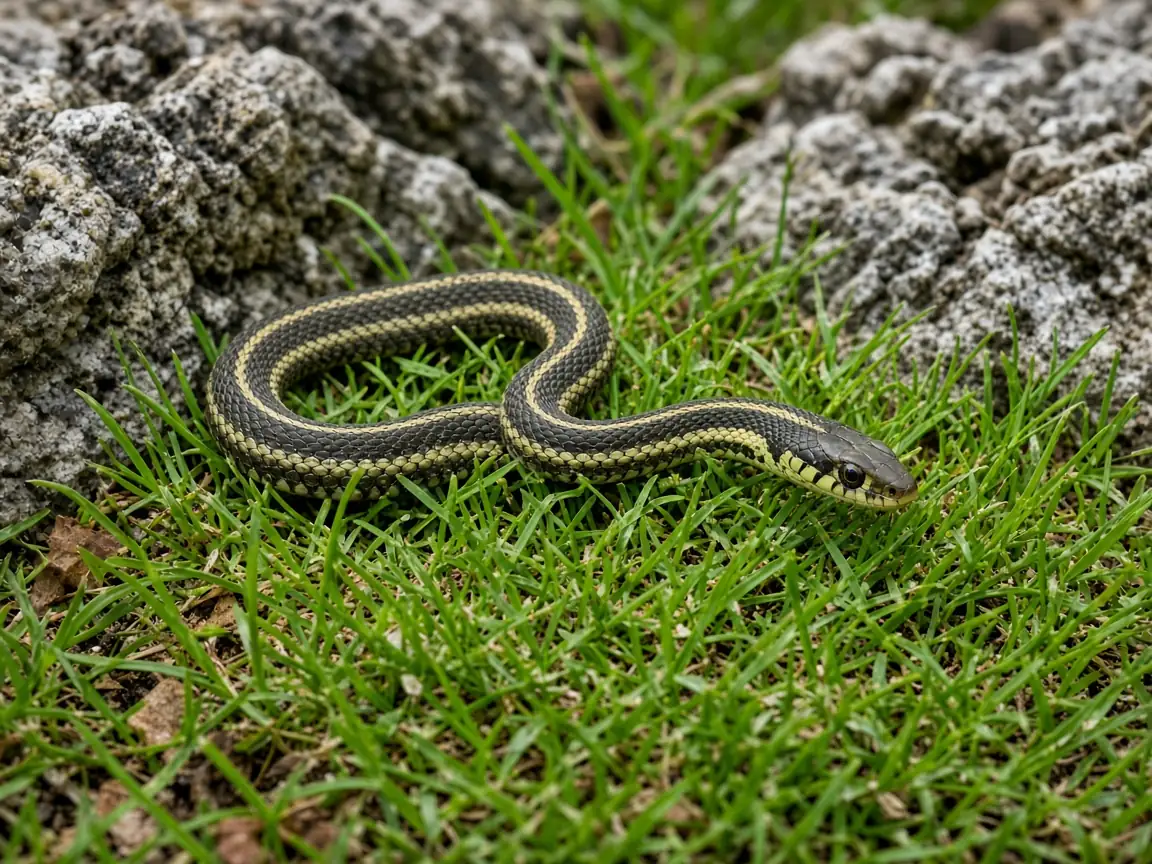
- Who: the red-sided garter snake, Thamnophis sirtalis parietalis, a northern subspecies of the common garter snake. Adult males average about 45 cm from snout to vent and females about 60 cm (Shine et al., 2004).
- Where: the Interlake region of central Manitoba, Canada, where the Narcisse Snake Dens hold what is described as the largest gathering of snakes on Earth.
- The ball: one female surrounded by as many as 100 males, all trying to mate with her at once.
Why do garter snakes form mating balls?
The short answer is numbers. Winters in central Manitoba are so cold that red-sided garter snakes have to gather in huge numbers in a few communal dens deep in the limestone, and they court and mate in early spring before spreading out to their summer feeding grounds (Shine et al., 2004). Males come up first and wait. Females come up later, and most leave the den area less than three days after they emerge, but many males hang around the den for more than two weeks to catch each new female as she appears. The result is a den surface where males heavily outnumber females (Shine et al., 2004).
When a female crawls out, every male close enough to smell her heads straight for her. So many males arrive at once that they pile on top of each other and the female ends up at the centre of a writhing knot of snakes. Manitoba's wildlife service says a single female can be surrounded by up to 100 males in one of these mating balls.
How do the males find a female?
By scent, using their sensitive vomeronasal system (Shine et al., 2004; see our snake anatomy guide). In 1989, Robert Mason and colleagues identified the female sex attractiveness pheromone of the red-sided garter snake. It is a set of long-chain methyl ketones that do not evaporate into the air, and synthetic versions attracted males in field tests (Mason et al., 1989).
The scent also tells a male which females are worth the effort. Courting males can judge a female's body length and body condition from chemical cues alone (Shine et al., 2003), and larger females are more attractive to males (Shine et al., 2001b). Males also follow the scent trails females leave on the ground as they move away from the den (Shine et al., 2004).
What are "she-males"?
The strangest part of the story involves males that smell like females. In 1985, Mason and David Crews reported that a small share of males release a female-like pheromone and draw courtship from other males. In the field they saw groups of 5 to 17 males gathered around one of these "she-males" (Mason & Crews, 1985).
Later work at a den near Inwood, Manitoba, found that she-males were males that had only just come out of hibernation and had not yet got their full strength back. The balls around them were smaller than those around real females and mostly made up of smaller males (Shine, O'Connor & Mason, 2000). So what does a she-male gain? Richard Shine and colleagues argued in Nature that the payoff is warmth and cover: a crowd of males lying on top of a cold, sluggish snake passes heat to it and shields it from predators after it emerges (Shine et al., 2001a).
Is a mating ball dangerous for the snakes?
It can be. A study of more than 1,000 dead snakes at the Manitoba dens found three main causes of death. Crows killed 590 snakes, mostly small ones. Another 301 snakes suffocated under massive piles of other snakes inside the den, mostly small males and, to a lesser degree, large females. A further 142, mostly females, died emaciated, probably because their energy reserves ran out (Shine et al., 2001b).
What happens after mating?
Garter snakes mate quickly compared with other snakes, and the male then leaves a thick, jelly-like plug in the female's cloaca. Experiments showed that the plug physically stops other males from mating with her for less than 72 hours, which is usually long enough for her to lose interest in mating or leave the den area. Males also make larger plugs for larger females, and smaller plugs after they have already mated a few times (Shine, Olsson & Mason, 2000).
The plug is not a perfect lock, though. Litters with several fathers are common in this population, and a 2013 study found sperm spread right through the plug, which suggests it also works like a slow-release sperm package as it dissolves (Friesen et al., 2013).
Where can you see garter snake mating balls?
The best-known site is the Narcisse Snake Dens in the Narcisse Wildlife Management Area, about 6 km north of the village of Narcisse on Highway 17 and roughly 130 km from Winnipeg. There are four active dens linked by a 3 km self-guided trail with viewing platforms (Manitoba Natural Resources). Canadian Geographic puts the population at around 75,000 to 150,000 snakes, overwintering in limestone sinkholes.
Highway 17 crosses the snakes' migration route, and in the late 1990s about 30,000 snakes were killed on it each year. Tunnels were later bored under the road about every 100 metres along a 1.5 km stretch, with low fences to steer snakes into them, and Mason painted the tunnels with synthetic garter snake pheromone to lure them through. The yearly road toll dropped to about 1,500 (Canadian Geographic). Roads matter in another way too: males were worse at following a female's scent trail across a gravel road (Shine et al., 2004).
Researchers describe red-sided garter snakes as non-venomous (Shine et al., 2004), and Manitoba calls them harmless, but the province still asks visitors to watch from the platforms. Leave the snakes where they are, and read our snake safety guide before any trip.
⚠️ Venom labels may be wrong. Treat every snake as potentially dangerous. See the safety warning above.
Keep exploring: other snake species, our venomous-or-not ID guide, snake habitats, a snake that needs no mate at all, how long snakes go without eating, snake myths and the .
FAQ
Why do garter snakes form mating balls?
Because males far outnumber females at the dens in spring. Every male that smells a newly emerged female tries to court her at once, so they pile up around her (Shine et al., 2004).
How many males are in a garter snake mating ball?
Manitoba's wildlife service says up to 100 males can surround one female at the Narcisse Snake Dens.
When do garter snakes form mating balls?
In early spring, just after they leave their winter dens. At Narcisse the mating lasts one to three weeks in late April or early May, depending on the weather.
What is a she-male garter snake?
A male that gives off a female-like scent and attracts other males (Mason & Crews, 1985). The warmth and cover of the crowd may help it recover after hibernation (Shine et al., 2001a).
Can snakes die in a mating ball?
Yes. At the Manitoba dens, 301 snakes in one study suffocated under piles of other snakes, mostly small males and some large females (Shine et al., 2001b).
Sources
- Shine, R., Phillips, B., Waye, H., LeMaster, M., & Mason, R. T. (2001a). Benefits of female mimicry in snakes. Nature, 414, 267. doi:10.1038/35104687
- Mason, R. T., Fales, H. M., Jones, T. H., Pannell, L. K., Chinn, J. W., & Crews, D. (1989). Sex pheromones in snakes. Science, 245(4915), 290–293. doi:10.1126/science.2749261
- Mason, R. T., & Crews, D. (1985). Female mimicry in garter snakes. Nature, 316, 59–60. doi:10.1038/316059a0
- Shine, R., O'Connor, D., & Mason, R. T. (2000). Female mimicry in garter snakes: behavioural tactics of "she-males" and the males that court them. Canadian Journal of Zoology, 78(8), 1391–1396. doi:10.1139/z00-089
- Shine, R., LeMaster, M. P., Moore, I. T., Olsson, M. M., & Mason, R. T. (2001b). Bumpus in the snake den: effects of sex, size, and body condition on mortality of red-sided garter snakes. Evolution, 55(3), 598–604. doi:10.1554/0014-3820(2001)055[0598:BITSDE]2.0.CO;2
- Shine, R., Olsson, M. M., & Mason, R. T. (2000). Chastity belts in gartersnakes: the functional significance of mating plugs. Biological Journal of the Linnean Society, 70(3), 377–390. doi:10.1111/j.1095-8312.2000.tb01229.x
- Friesen, C. R., Shine, R., Krohmer, R. W., & Mason, R. T. (2013). Not just a chastity belt: the functional significance of mating plugs in garter snakes, revisited. Biological Journal of the Linnean Society, 109(4), 893–907. doi:10.1111/bij.12089
- Shine, R., Phillips, B., Waye, H., LeMaster, M., & Mason, R. T. (2003). Chemosensory cues allow courting male garter snakes to assess body length and body condition of potential mates. Behavioral Ecology and Sociobiology, 54(2), 162–166. doi:10.1007/s00265-003-0620-5
- Shine, R., Lemaster, M., Wall, M., Langkilde, T., & Mason, R. (2004). Why did the snake cross the road? Effects of roads on movement and location of mates by garter snakes (Thamnophis sirtalis parietalis). Ecology and Society, 9(1), 9. doi:10.5751/ES-00624-090109 (open access)
- Province of Manitoba, Natural Resources: Narcisse Snake Dens (season, mating balls of up to 100 males, four dens, trail and location).
- Canadian Geographic: Snakes on a plain: Manitoba's Narcisse Snake Dens (population estimate, Highway 17 tunnels and road mortality).
Cite this page
APA: SnakeWise. (2026, October 20). Why Do Garter Snakes Form Mating Balls? The Narcisse Snake Dens Explained. SnakeWise. https://snakewise.org/blog/why-do-garter-snakes-form-mating-balls.html
MLA: "Why Do Garter Snakes Form Mating Balls? The Narcisse Snake Dens Explained." SnakeWise, 20 Oct. 2026, snakewise.org/blog/why-do-garter-snakes-form-mating-balls.html.
Chicago: SnakeWise. "Why Do Garter Snakes Form Mating Balls? The Narcisse Snake Dens Explained." SnakeWise. October 20, 2026. https://snakewise.org/blog/why-do-garter-snakes-form-mating-balls.html.