Snake myths vs facts
Many popular beliefs about snakes are wrong: snakes are not slimy, they do not unhinge their jaws, they do not chase people, and you cannot reliably spot a venomous snake by head or pupil shape. Here are common snake myths and the facts.
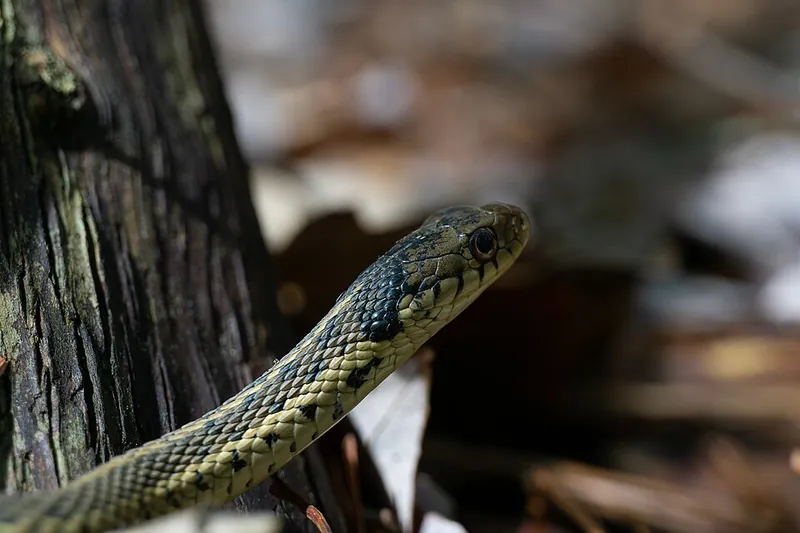
Are snakes slimy?
Myth: Snakes are slimy.
Fact: Snake skin is dry and smooth, made of keratin scales.
Do snakes unhinge their jaws?
Myth: Snakes unhinge their jaws.
Fact: Their jaws are joined by stretchy ligaments, letting them open wide without dislocating.
Can you tell a venomous snake by its head shape or pupils?
Myth: You can tell a venomous snake by its head shape or pupils.
Fact: Many exceptions exist; for example cobras and mambas have round pupils and slender heads. Treat unknown snakes with caution.
Are baby snakes more dangerous than adults?
Myth: Baby snakes are more dangerous because they can't control venom.
Fact: Evidence doesn't support this; adults usually deliver far more venom.
A 2026 study of 48 southern Pacific rattlesnakes also found that larger snakes released more venom in defensive bites. Read about the rattlesnake venom study.
Do snakes chase people?
Myth: Snakes chase people.
Fact: Snakes avoid humans. Apparent 'chasing' is usually a snake fleeing toward cover that happens to be behind you.
Should you suck out venom or use a tourniquet?
Myth: Sucking out venom or using a tourniquet helps.
Fact: These are harmful. Keep calm, keep still, and get to medical care quickly.
Are snakes deaf?
Myth: Snakes are deaf.
Fact: They lack outer ears but detect vibrations and some low-frequency sounds.
Can you tell a rattlesnake's age by its rattle?
Myth: A snake's age equals its rattle count.
Fact: Rattlesnakes add a segment each shed, which can happen several times a year, and segments break off.
The rattle is also a warning signal. A 2026 study of 220 snakes from 73 species found that warning sounds such as rattling and hissing grew longer and generally louder as a threat increased, with bites coming mainly at the highest threat level. Read about the warning-sound study. For more on why a new segment is added at every shed rather than every year, see why and how snakes shed their skin.
Do all snakes lay eggs?
Myth: All snakes lay eggs.
Fact: Many, including boas, most vipers and garter snakes, give birth to live young.