Are Snakes Cold-Blooded? How They Warm Up and Cool Down
Yes. Snakes are ectotherms, the animals people call cold-blooded. They do not hold a steady warm body temperature the way birds and mammals do. They warm up by basking or by lying on a warm surface, and they cool down by moving into shade or cover. A snake that has been in the sun can be warm, so cold-blooded does not mean its body is always cold.
What does cold-blooded mean?
Cold-blooded is the everyday name for ectothermy. Smithsonian's National Zoo states that all snakes are ectothermic, which means they rely on the temperature of their surroundings to maintain body temperature. The Australian Museum describes reptiles, the group that includes snakes, the same way: body temperature varies with the outside temperature, and the museum lists reptiles as cold-blooded. Montana Fish, Wildlife & Parks states the practical side. Snakes do not produce their own internal heat. They raise body temperature by absorbing heat, and they lower it by giving heat off.
How do snakes warm up?
They do it mostly by moving to a better spot. The San Diego Zoo Wildlife Alliance explains that reptiles must bask in the sun or find a warm spot before they become fully active. Smithsonian's National Zoo describes a cautious version of that behavior. To warm up, a snake may put only part of its body in a sunny spot and keep the rest concealed, because sitting fully in the open makes it easier for a predator to see.
The Washington Department of Fish & Wildlife explains how a snake adjusts the bask. Most snakes reach a preferred body temperature by basking on surfaces in the sun. They move in and out of the light, and they change which way they face, sometimes toward the sun and sometimes with the back turned. They also pick up heat by lying on or under a warm surface. Montana's wildlife agency describes the same choice: sun, or a heated surface, to raise body temperature.
None of these pages names one temperature for every species. In hot areas, Washington's wildlife department says snakes often bask in the morning on asphalt, concrete, rocks and wooden fences. In cooler regions, the same page says they may bask through more of the day.
How do snakes cool down?
Warming up is only half of the job. The San Diego Zoo notes that reptiles must find shade or another cool spot when they need to cool off. Montana Fish, Wildlife & Parks says snakes have to take cover in cooler places to lower body temperature, which is why shelter matters as much as sun. Moving out of the light is how a snake stops gaining heat.
In cold conditions, the San Diego Zoo says reptiles become sluggish and do not move around much. A slow snake can still bite if it is grabbed, so do not pick one up.
Why is a snake on a rock or a road?
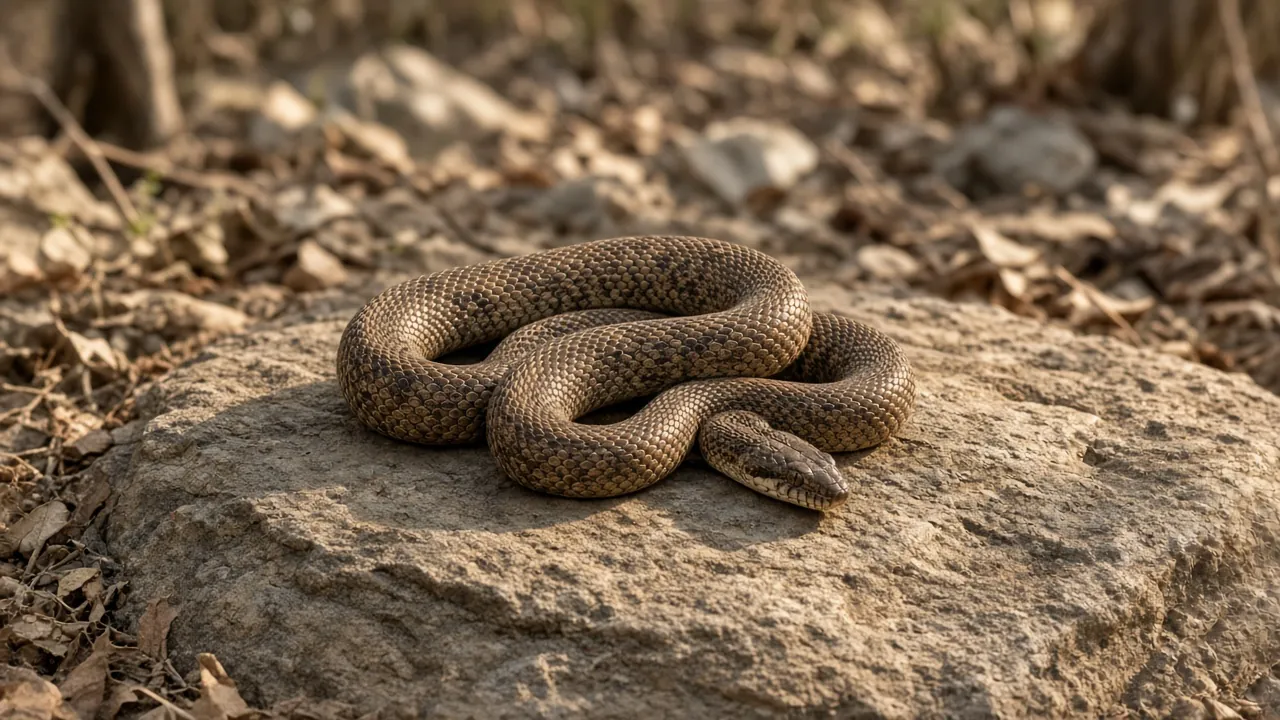
A flat rock or a paved road holds the sun's heat, so it is a useful place to warm up. Washington Department of Fish & Wildlife notes that snakes bask on sun-warmed roads in the evening, and that this often leads to them being run over.
If you see a snake in one of those places, give it room. Smithsonian's National Zoo says that if you encounter a snake, the best thing to do is leave it and give it space. The Australian Museum notes that reptiles are shy and will usually escape rather than attack when they have the chance, and that most bites happen while people are trying to catch or kill a snake. Do not pick a snake up to move it off a road. The same idea applies in a garden: our yard-snake guide says to keep people and pets back and let the animal leave.
If someone is bitten, call local emergency services or poison control before anything else. In the United States that is 911, and Poison Control is 1-800-222-1222. Follow the dispatcher's instructions. Keep the person as still as is practical, and do not try to catch the snake. Our snake safety page repeats those emergency-first steps. This page cannot identify a snake, so do not come closer to check. The identification guide is for reading from a safe distance only.
What do snakes do in cold weather?
Where the season turns cold, activity drops. The San Diego Zoo says that in cold conditions reptiles become sluggish, and that some enter torpor or brumation, a resting state it compares to hibernation, when the cold will last a long time. Washington Department of Fish & Wildlife says snakes in Washington hibernate in winter, either alone or in a shared den, and that in mild areas they may come out briefly to feed and bask during a warm spell. Those descriptions are about cold weather and about Washington. They are not one calendar for every snake. The habitats guide covers snakes that spend a cold season inactive.
Can a snake make its own heat?
For ordinary daily life, the wildlife agencies cited here describe snakes as animals that gain and lose heat from outside the body. Smithsonian's National Zoo describes a real exception while eggs are being incubated. Some snakes, especially many python species, can produce heat then. A brooding python coils around the clutch and contracts its muscles quickly, in a movement that looks like a twitch. Those contractions raise its body temperature, and more twitching produces more heat. The zoo also says the parent uses the heat-sensing pits on its face to check the eggs, then twitches more or less as needed.
That is a short period of warming for a clutch, not the steady internal heat of a mammal. How some snakes sense infrared with those pits is explained in can snakes see heat?
What about a pet snake?
A pet snake is the same kind of animal. It still depends on the temperature around it. The pet snake guide explains why a captive snake needs a warm end and a cool end, with the heat source on a thermostat, rather than one even temperature for the whole enclosure. Needs differ by species. If a pet snake stops moving normally, will not feed, or seems hurt, contact a veterinarian who treats reptiles.
FAQ
Are snakes cold-blooded or warm-blooded?
They are cold-blooded in the everyday sense. They are ectotherms, and body temperature follows the surroundings instead of being held steady from the inside.
Does cold-blooded mean a snake is always cold?
No. Body temperature changes with the place the snake is in. A snake that has been basking can be warm.
Why do snakes lie in the sun?
Basking, or lying on a warm surface, is how they raise body temperature so they can be active. They leave the sun, or take cover, when they need to cool down.
Do snakes hibernate?
In cold conditions many reptiles become sluggish, and some enter torpor or brumation, which the San Diego Zoo compares to hibernation. Washington's wildlife department says snakes there hibernate in winter. Not every climate has that kind of winter.
What should I do if I see a snake basking?
Keep your distance and let it leave. If someone is bitten, call local emergency services or poison control first. Do not try to catch the snake.
Can pythons warm their eggs?
Smithsonian's National Zoo says many pythons coil around their eggs and twitch their muscles to produce heat, and use the heat pits on the face to check the clutch.
Explore more: what ectotherm means, where snakes live, heat for a pet snake, snake safety, can snakes see heat?
Sources
- Do Snakes Have Ears? And Other Sensational Serpent Questions, Smithsonian's National Zoo and Conservation Biology Institute (accessed 18 Nov 2026)
- Reptiles, San Diego Zoo Wildlife Alliance (accessed 18 Nov 2026)
- Reptiles, Australian Museum (accessed 18 Nov 2026)
- Living with Snakes, Montana Fish, Wildlife & Parks (accessed 18 Nov 2026)
- Living with wildlife: Snakes, Washington Department of Fish & Wildlife (accessed 18 Nov 2026)
Cite this page
APA: SnakeWise. (2026, November 18). Are Snakes Cold-Blooded? How They Warm Up and Cool Down. SnakeWise. https://snakewise.org/blog/are-snakes-cold-blooded.html
MLA: "Are Snakes Cold-Blooded? How They Warm Up and Cool Down." SnakeWise, 18 Nov. 2026, snakewise.org/blog/are-snakes-cold-blooded.html.
Chicago: SnakeWise. "Are Snakes Cold-Blooded? How They Warm Up and Cool Down." SnakeWise. November 18, 2026. https://snakewise.org/blog/are-snakes-cold-blooded.html.